top of page

Discover the AI Usage Classifications Standard

Purpose

The AI Usage Classification™ (AIUC) exists to promote transparency, accountability, and clarity in how artificial intelligence is applied across different domains of work. Its purpose is not to evaluate the quality or ethics of  (AI) use, but to provide a simple, shared language for organisations and individuals to describe the level of AI involvement in the generation, creation, design or development of artefacts, content, and products, in professional, personal and creative settings.

By supporting honest disclosure, the classifications enable stakeholders - including clients, regulators, consumers and communities - to understand when and how AI is used, fostering trust, informed engagement, value assessment, and responsible innovation.

AIUC Global with Slogan

Scope

The AI Usage Classifications™ are available to organisations and individuals with an approved registration or certification for usage on and in artefacts, content or products that have been generated, created, designed, developed, or executed.

This page should be read in conjunction with the AI Usage Classification Code of Practice.

Implementation

The implementation of the AI Use Classifications requires a structured approach to ensure consistent and meaningful adoption across the organisation.

Organisations should first consider what levels of AI involvement are appropriate and acceptable for their products and deliverables, taking into account their market, regulatory environment and customer expectations.

Documenting this intent - along with planned rollout activities and example usage scenarios - not only streamlines the process of becoming a registered user of the classifications but also maximises the benefits of transparent and responsible AI use.

Benefits

Leveraging the classifications has the following benefits:​

  • The classifications promote transparency by providing a consistent language for disclosing the role of AI in professional, personal and creative settings, helping stakeholders understand the various levels of human involvement and where and to what extent AI was utilised to generate, create, design, develop or execute the artefacts, content or products.

  • It enhances stakeholder confidence when delivery organisations signal their commitment to ethical, transparent and well-governed AI practices.

  • The classifications help organisation align internal AI use with their policies, risk appetite and sector expectations without imposing restrictive or value-laden judgements.

  • It supports more efficient operations by encouraging responsible use and experimentation with AI while maintaining accountability through appropriate classification and review.

Abstract White Waves

AI Usage Classifications Guide

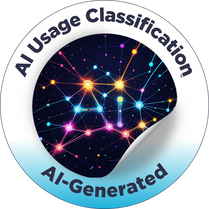
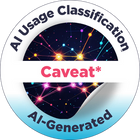
The AIUC Global standard defines five core classifications (plus three variation categories) to transparently declare AI-Human involvement in artefacts, content, products, or processes. Use the table below to understand definitions and practical applications.

Note: The below examples are provided for demonstration purposes only. They illustrate how AI Usage Classification badges can be applied across different types of content and scenarios, and do not indicate verified authorship or provenance.

Core Classifications

Classification: AI-Free

When no AI is used in the generation, creation, design or development of the artefact, content, product or process.


Example Use Cases (click to zoom in): 

  • A handmade sketch drawn entirely by an artist using traditional pencils and paper.

  • A business plan written solely by a human strategist through manual drafting and revisions.

AIUC Examples of AI-Free Classification

Variation Categories

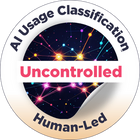
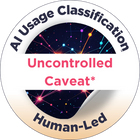
Classification: Uncontrolled (AI-Free | Human-Led Co-Created | AI-Led | AI-Generated)

When documents are released in an editable format outside the licensee’s control, they must include an "Uncontrolled" badge. This indicates the artefact was editable when classified, highlighting potential for external modifications.


Example Use Cases

  • A draft business proposal released as a .docx to a client team for their modifications.

  • A PowerPoint deliverable shared in editable .pptx format with a client for customisation.

AIUC Examples (3).png
AIUC Examples (4).png

Get your license now

As part of the licence registration process, you will receive access to the applicable set of badges for use in your products, artifacts, or content as per the Code of Practice.

bottom of page